

Give It to Me Bi: Married, but Wondering
At this point, we're professional bisexuals. Give It To Me Bi is a bi-weekly advice column in which your favorite Bisexual Killjoys answer your questions about being bi+.

Q.
Dear Bailey & Jace,
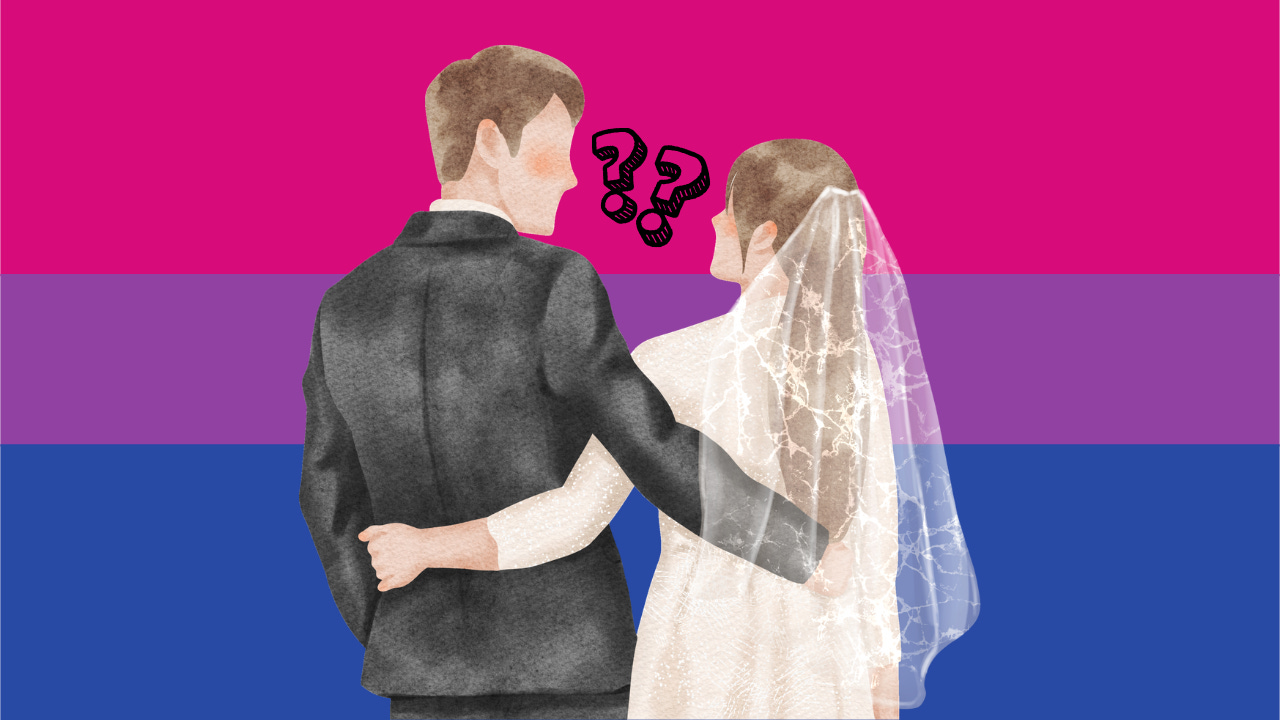
Thank you for your work. BKJ is one of the first places I’ve felt seen in a long time. I’ve been married to a man for over 30 years, and we have three young-adult children. Our relationship has had its struggles, but after therapy and some life stability, it’s in a better place, though I still feel something is missing. About three years ago, I began experiencing attraction to women. I didn’t act on it, and only shared it this past summer when my husband brought it up. He isn’t open to non-monogamy, and we’ve both been in therapy. I’ve told myself I need to mourn this part of me to preserve my family. But when I opened up to a close friend, she suggested my attraction to women is really about dissatisfaction in my marriage, not my identity. I’ve heard similar ideas elsewhere, and while they feel invalidating, they’ve also shaken me. How do I make sense of this?
Sincerely,
Married, but Wondering
A.
Dear Married, but Wondering,
Let’s start by naming the thing that’s happening here (because everyone around you seems dead set on calling it something more convenient for them): You’re attracted to women.
How do I know that? Because you said you’re attracted to women. But instead of taking that fact at face value, the people around you keep trying to tell you that you mean something else. You say you’re attracted to women, but what you must mean is that you’re dissatisfied. Or that this attraction is a symptom of something deeper and more menacing.
Friend, it sounds like working through your issues with your husband allowed you to learn some things about yourself. That isn’t a metaphor or anything, either. Literally, you worked on your marriage, work that I imagine included independent work, and you gained new information about yourself. Who would be a better expert on your attraction than you?
Back to the plot: Discovering something new about your attraction does not automatically point to some issue that needs to be unravelled by your local seer. Sometimes attraction is just attraction. Now, that doesn’t mean your marriage is irrelevant. It clearly matters to you. You’ve put in work, you’ve raised a family, and you’ve fought for something that is, by your own account, in a better place than it used to be. That deserves acknowledgement.
But here’s where I think people around you are doing you a disservice. They are collapsing two questions into one:
What is my sexual orientation?
How satisfied am I in my relationship?
Those questions can influence each other. They can even interact in complicated ways. But they are not the same question. And right now, everyone in your life seems awfully invested in answering the second question for you while dismissing the first. Because it’s easier for them to understand.
If your attraction to women is “just” about dissatisfaction, then the solution is neat: fix the marriage, deepen intimacy, trust your husband more, and the problem goes away.
But if your attraction to women is real (i.e., part of your orientation), then there is no clean fix. There is only complexity. There are trade-offs and decisions that don’t resolve neatly into “and then everyone was happy.” So people reach for the simpler story. That doesn’t make it true.
Let’s also talk about timing, because this is another place where people tend to get dismissive. The idea that if something is “real,” you would have known earlier is one of the most persistent myths about bisexuality, especially for women.
You built a life within a heterosexual framework. You got married. You had children. You invested decades into a relationship that, by all external measures, made sense. There may not have been space for your attraction to women to even register as a possibility, let alone something worth naming.
And then, three years ago, it did. That “sudden” arrival doesn’t make the attraction less real. If anything, it makes it more significant because it broke through anyway!
What concerns me most in your letter isn’t just that people are questioning your attraction. It’s that you’ve started to internalize the idea that this part of you must be mourned in order to preserve your life. That’s a heavy sentence to pass on yourself, beloved.
And look, sometimes we do make choices that involve loss. You may ultimately decide to remain in a monogamous relationship with your husband. That is a valid choice. It is a choice many people make, for many reasons. I’m in a monogamous relationship with my husband, which means that I won’t pursue other avenues of attraction. That’s not a loss for me.
But there is a difference between choosing not to act on something and deciding that something isn’t real, or doesn’t matter, or needs to be buried to keep the peace. You don’t have to erase your identity to stay in your marriage. You don’t have to agree with your friend that your attraction is “anecdotal” (which, frankly, is a fucking wild thing to say to someone about their own experience). You don’t have to adopt your husband’s therapist’s framework as your own.
You definitely don’t need to believe that if your marriage were just “good” enough, this part of you would disappear. That’s not how bisexuality works.
Now, I’m going to push you a little, because you came to a Killjoy, not a Makejoy.
You’ve done a lot of thinking about how to preserve your family. You’ve done a lot of work to stabilize your relationship. You’ve taken on the emotional labor of making sense of this in a way that minimizes disruption. I don’t see as much curiosity about yourself. Not just “What do I do with this?” but “What is this actually like for me?”
What does your attraction to women feel like?
What kinds of connections do you imagine?
What parts of you come alive in those moments of recognition?
What have you been taught about desire to dismiss and/or minimize?
Right now, you’re being asked to decide the meaning of something you haven’t been allowed to explore without it being immediately redirected into a problem to solve. That’s not fair.
Here’s the thing, and I know this reply took some time to get to you (sorry): You don’t need to rush to a conclusion about what this means for your marriage. You also don’t need to accept other people’s interpretations as more authoritative than your own.
Allow me to leave you with some things to remember as you learn to trust yourself:
You can love your husband and still be bisexual.
You can have a “better than it used to be” marriage and still feel something is missing.
You can choose monogamy and still experience desire for people outside that structure.
You can build a meaningful life and still discover new parts of yourself decades in.
The discomfort you’re feeling isn’t a sign that something is wrong with you. It’s a sign that you’re holding multiple truths at once in a world that prefers you to pick one.
If you take anything from this, let it be this: You don’t have to decide today what to do with your attraction to women, but you do need to stop letting other people decide what it means. And if your friends give you any guff, find some new friends.
Start there.
Be well,
Bailey
Was there something that resonated with you about this post?
Have a question or situation you could use advice on?
Share your story with us to be featured in a future Give It to Me Bi+ entry!