

Give It To Me Bi: I'm Out to Me...Now What?
At this point, we're professional bisexuals. Give It To Me Bi is a bi-weekly advice column where your favorite Bisexual Killjoys answer all your questions about being bi+.

Q.
Dear Bailey & Jace,
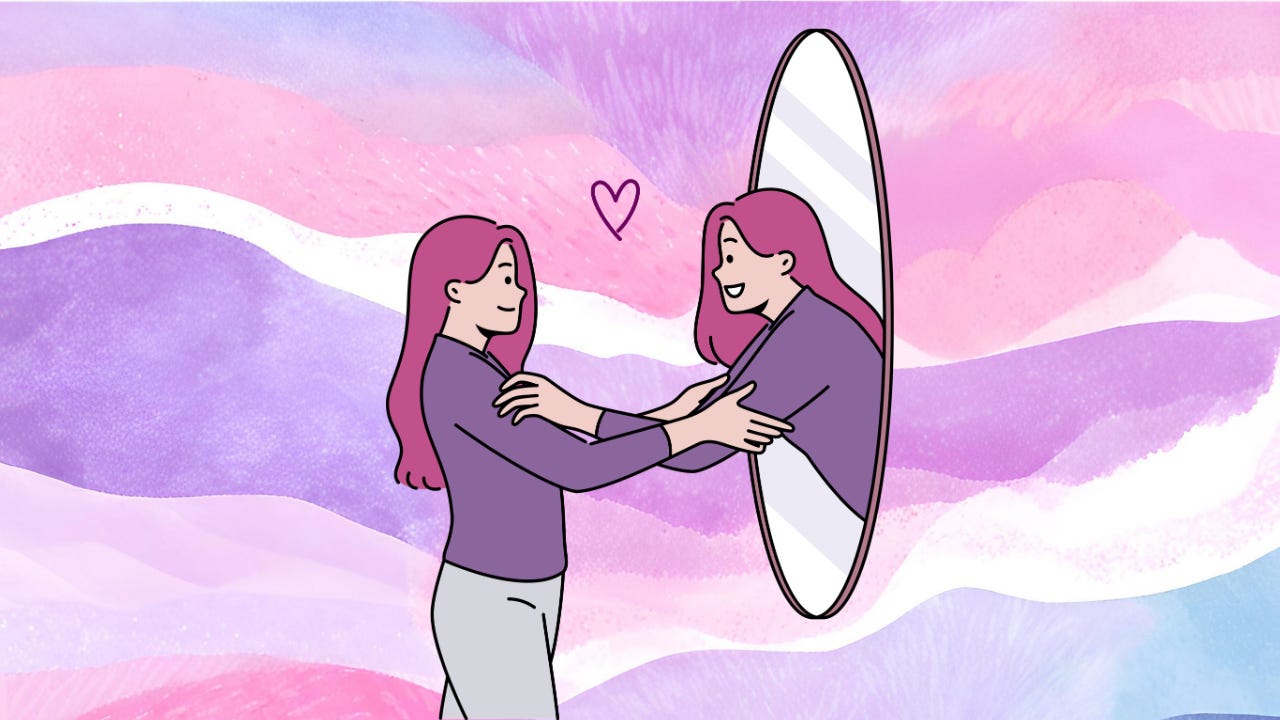
I always thought I was straight. I had queer friends growing up, a sister who dated women, and bi and lesbian friends who joked that they’d try to “turn me gay,” but I never felt any attraction to women. Then around 25, I noticed I was maybe attracted to a woman, but I brushed it off as just thinking she was pretty. Now, ten years later, I’ve cut off my abusive family and I’m finding my voice after years of feeling suppressed and mute. And at the same time, I’m experiencing this continuously budding attraction to women. It doesn’t feel like curiosity. It feels like identity, which is exciting but also really destabilizing. I always imagined myself with a man, maybe marrying a man and having children. Now it feels like my life plan has suddenly become more complex, maybe richer, but still more complex. Is this what it’s like sometimes? How do I come out to myself when I’m not even sure what to do with what I’m feeling? And how do I start exploring this when the nerves make me want to run away?
Sincerely,
Bi, Not Curious
A.
Dear Bi, Not Curious,
Sometimes our identity arrives like a trumpet blast then you and everyone around you cheers and starts throwing a parade. More often it arrives like a wet cat at the back door: pissed off, shaking, yours through destiny, and ready to ruin your evening plans.
Beloved, it sounds to me that you’ve spent a long time surviving. I get that. When you grow up in an abusive environment, your body and mind are not usually sitting around asking, “What is the fullest, freest, most erotically and romantically honest version of me?” They are trying to get you through the day. They are trying to keep you safe. They are trying to make sure you don’t become a bigger target.
So, here you are: You’ve cut off the toxic parts of your family tree, you’re finding your voice (which can be a lot more complicated when you’ve been forced to be mute for most of your life), and you’ve started to notice a budding attraction to women. My reaction isn’t: “Hm, weird!” It’s: “Of course your inside thoughts got louder when you were finally allowed to listen to yourself.”
This part isn’t for you but I feel compelled to say it anyway: Abuse doesn’t make people bisexual or queer or whatever other shitty takes conservatives have.
But trauma can bury parts of us. It can make certain feelings inaccessible. It can teach us that wanting anything is dangerous. It can train us to follow the safest script available, and for a lot of people, that script is heterosexuality. Not because heterosexuality is fake, but because it is often the path of least resistance.
You may have been attracted only to men for a long time. But you may have also had attraction to women sitting somewhere deep inside of you.
Right now, you’re experiencing a shift. People love to tell tidy coming-out stories because tidy stories are easier to put on tote bags. “I always knew.” “I had a crush on my best friend in kindergarten.” “I watched The Mummy and my bisexuality descended from the heavens in a beam of Brendan Fraser and Rachel Weisz-shaped light.”
And sure, sometimes that is true. Beautiful. Love that for them.
But not everyone always knew. Some people figure it out in their teens. Some people figure it out in their 20s, 30s, 40s, 50s, 60s, after marriage, after divorce, after childbirth, after loss, after sobriety, after therapy, after leaving religion, after leaving an abusive family, on and on.
So, You’re Curious
Now, let’s talk about the “bi, not curious” part, because I think you already know something important.
Curiosity is lovely. Curiosity gets a bad reputation because people sometimes use “bi-curious” to mean “I would like to borrow bisexuality and return it when it becomes inconvenient.” But curiosity itself is not the enemy. Curiosity is how we learn.
What I hear in your letter, though, is that this does not feel like a little question mark floating around your head. It feels deeper than that. It feels like recognition. Shaky recognition, maybe, but recognition all the same.
You are allowed to say, “I think I’m bi,” before you have a résumé of experiences. You are allowed to say, “I don’t know what this means yet, but I know it means something.” You are allowed to claim the identity in the privacy of your own mind. You are allowed to be scared of what this new identity might mean for your life.
Because yes, realizing you may be bi can make things feel more complex. People sometimes want us to pretend queerness is only be glitter and brunch. And listen, queerness can be joy. It can be hot. It can be funny. It can give you access to community, language, history, and parts of yourself you didn’t know existed.
It can also be, as you’ve so aptly said, destabilizing.
You had a plan. A man. Marriage. Maybe children. A recognizable future. And now your inner self has walked into the room and said, “What if there are other doors?” which is very rude behavior. Some of us were trying to get through fucking Pride season.
A more complex life is not necessarily a ruined life. Sometimes complexity is the cost of honesty.
The Road Less Traveled (something, something, Robert Frost)
I want to challenge the idea that attraction to women means your imagined future with a man disappears. It doesn’t. You can be bi and marry a man. You can be bi and have children. You can be bi and build a life that looks, from the outside, very similar to the life you once pictured. The difference is that you would be entering that life with more truth about yourself, not less.
Bisexuality does not mean every possible future must be pursued, which I think Jace and I have talked a lot about this season, particularly in the episodes on monogamy and marriage. It means more than one kind of future may be possible.
Abundance and overwhelm all at once.
So what do you do?
You do not have to decide today whether you will date women, marry a woman, come out publicly, change your wardrobe, update your dating apps, or become the mayor of Bisexual Township (though given the potential voting block power of the bi+ population, you could win in a landslide).
Right now, your job is to make room for your potential. The good news is that act can look very small. Read bi+ books. Listen to bi+ podcasts, and I say that as a completely unbiased podcast host with no agenda whatsoever. Follow bi+ creators. Journal without trying to be correct. Let yourself notice attraction without immediately cross-examining yourself. “Do I want to be her? Do I want to be with her? Do I want her jacket? Do I want her hand on my lower back in a kitchen at midnight?” Sometimes the answer is yes to several.
You can also practice saying it in low-stakes ways by asking yourself:
“I might be bi.”
“I think I’m attracted to women.”
“I’m figuring out my sexuality.”
“I don’t think I’m straight.”
“I’m bi.”
See what happens in your body. Not because your body will give you a perfect answer, but because it may tell you which words feel like a locked door and which words feel like a window opening.
On Dating
Shifting gears a little bit: Let’s talk about connecting with women.
You are grown, yes, but you are also new at this. Being new does not make you childish. It just makes you new. And because it just makes you new, I want to (lovingly) call bullshit on one part of your letter: “the nerves would make this grown woman run away.” Maybe they would. The first time. Maybe even the second time. So what?
Do not accept the narrative that you are simply “too scared” to engage with women, as if fear is a personality trait instead of a feeling. Fear is not an oracle.
You are scared because this is new. You are scared because it matters. You are scared because you find women are beautiful and intimidating. That does not mean you are incapable. It means you are under-practiced. I’m getting real tired of bi+ people telling me they can’t do something, can’t even try, because they are afraid.
Dating is a skill. Flirting is a skill. Tolerating the feeling of being perceived is, unfortunately, a skill. You are not born knowing how to ask a woman out without your nervous system trying to fake its own death. You learn by doing it badly, surviving, and doing it again slightly less badly.
If you try to flirt with a woman and panic, congratulations, you have joined a proud queer tradition. Half of queer history is people making intense eye contact with someone across a room and then immediately looking at a wall like that dog meme.
So don’t make “I’m too scared” your identity. Make “I’m learning” your identity.
You want some real advice? I’ll tell you what I tell everyone: You do not need to leap directly into dating if dating feels like being asked to set yourself on fire. Start with community. Start with spaces where you can be around queer women and bi+ people without the immediate pressure of romance or sex. Book clubs. Social events. Classes. Volunteer groups. May I interest you in the Bisexual Resource Center?
Let yourself be around the possibility of women before you demand that you act on it.
And when you do feel ready to connect with someone, you are allowed to be honest.
“I’m newer to dating women, and I’m a little nervous, but I’d like to get to know you.” The right person will not be horrified by that (and I won’t pretend that I haven’t seen this regressive take on social media). The wrong person may be weird about it, and then you will have learned something useful: not your person, not your door, keep walking.
Caring For Yourself
And because your letter is tied to abuse and finding your voice, I do want to say that it might be worth working through this with a trauma-informed therapist if you have access to one, especially someone queer-affirming (maybe you’re already doing this, but the advice remains). Not because your sexuality is a problem to solve or anything weird like that, but because your nervous system sounds like it has been through a war and is now trying to process all this fresh destabilization.
That’s a lot to carry alone.
You are allowed to need support. You are allowed to be both thrilled and freaked out. You are allowed to mourn the simplicity of the old story even if the old story was too small for you.
Because that’s the thing people don’t always tell you about becoming yourself: sometimes it feels amazing, and sometimes it feels like losing the person you were pretending to be. Even if pretending helped you survive. Even if the old plan was comforting.
But I don’t think you wrote to us because you want to “unknow” this. I think you wrote because some part of you wants permission to trust it.
So here is my permission, for what it’s worth: Trust that something real may be happening. Trust that you do not have to know exactly what it means yet. Trust that attraction can emerge, shift, deepen, or finally become visible when you are safer. Trust that being nervous does not mean you are wrong. Trust that your life becoming more complex does not mean it is falling apart.
It may be getting bigger. And yes, bigger can be scary. Bigger means more rooms to walk into. More versions of yourself to meet. More chances to be clumsy. More chances to want something you don’t yet know how to hold.
You will learn.
With love & admiration,
Bailey
Was there something that resonated with you about this post?
Have a question or situation you could use advice on?
Share your story with us to be featured in a future Give It to Me Bi+ entry!
Wow I feel seen